
Walker Scheduled and Actual Releases
A projected date is a calculation, not proof that release occurred. A person awaiting trial at Walker County Jail usually has no sentence-based release date. Bond, a court order, dismissal, transfer, or a later sentence may end that local stay. For a sentenced Georgia prisoner, GDC computes dates from the sentence, jail credit, special instructions, non-running time, and eligible credits.
Georgia rules distinguish a Maximum Release Date from a Tentative Parole Month. The maximum date assumes the full prison term is served, apart from parole action. A TPM is the planned month for final parole review. It can be postponed or canceled and is not a promise of release.
Find a Walker County Release Date
Choose the source by custody, not merely by residence. The GDC offender search covers state offenders and people transferred from Walker County Jail into Georgia custody. It does not function as the local jail roster. County jail dates come from sheriff detention records and the court case.
- Confirm full name, date of birth, and a booking, case, or GDC number if available.
- For Walker County Jail, call detention or AIS and check the sentencing court docket.
- For Walker State Prison or another GDC facility, search GDC and read custody, sentence, and release fields.
- Check the Inmate TPM Lookup only when parole consideration applies.
- Verify an uncertain GDC result in writing with Inmate Records and Information, PO Box 1529, Forsyth, GA 31029.
- After the date passes, obtain the actual release or discharge entry from the record holder.
The official TPM page illustrates the separate parole-planning channel.
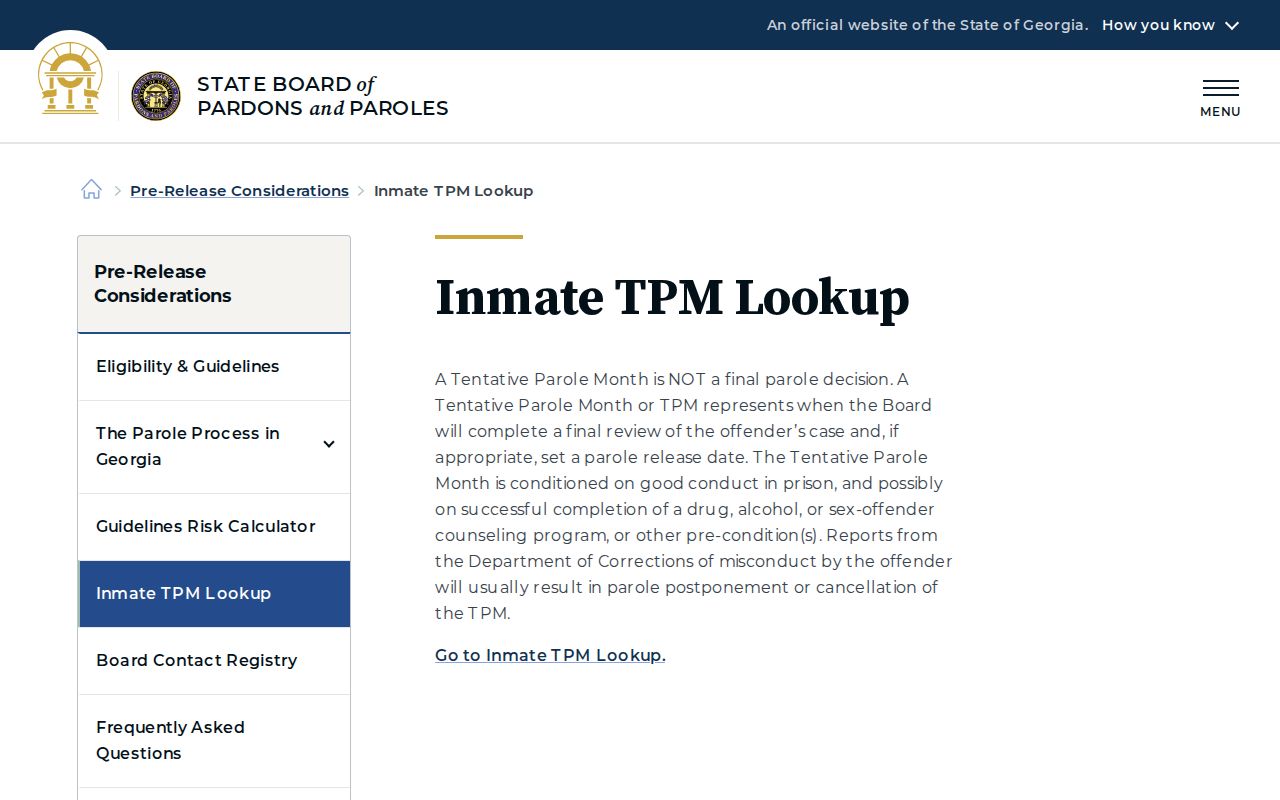
A TPM result should always be read as tentative and checked against later GDC and Parole Board action.
Walker State Release Credit Rules
Georgia's Performance Incentive Credit program can change a qualifying state offender's TPM or maximum date. GDC says eligible offenders may earn up to 12 points, potentially reducing a date by one to twelve months. Credits can relate to case-plan programs, education or vocational progress, and work assignments. Exclusions include probationers, death sentences, sentences of two years or less, non-parole-eligible or mandatory-minimum offenses, and life sentences.
O.C.G.A. 42-5-101 authorizes work incentive credits for eligible felony prison terms other than life imprisonment. It permits credit tied to approved programs, work, and conduct. The Parole Board considers reported credits in final parole decisions. A credit is not the same as an executed release.
The GDC PIC program page shows the current framework.
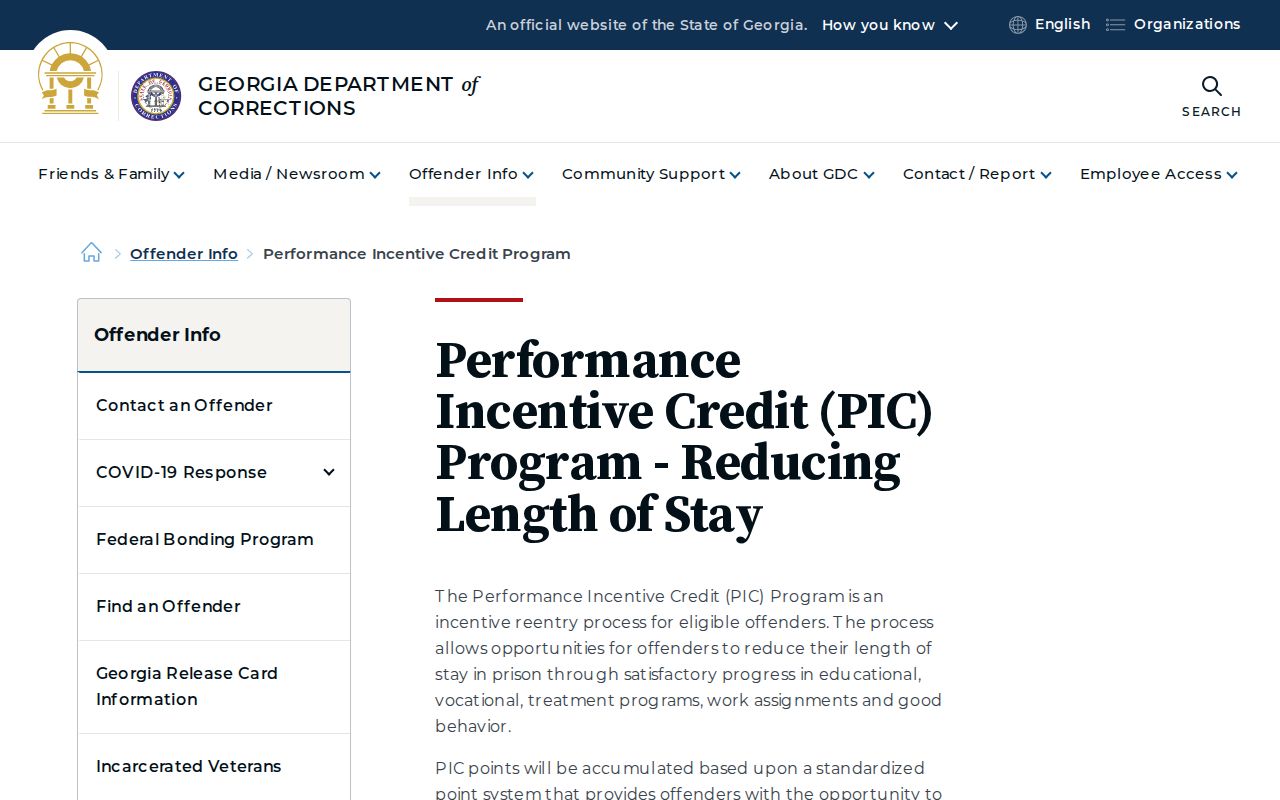
Only the person's official computation shows whether credits actually affected a date.
Why Walker Release Dates Change
Sentence dates move when the inputs or legal status change. GDC rules account for jail credit, special sentencing terms, maximum sentence length, time that does not run, earned credits, and detainers. A detainer is a notice that another agency may take custody. It can cause transfer rather than community release when one sentence ends.
| Change | Possible effect |
|---|---|
| Credit correction | Moves the computed sentence end |
| PIC or work credit | May reduce an eligible state date |
| Misconduct | May postpone or cancel a TPM |
| Detainer or hold | May cause transfer instead of release |
| Court order | Can change the controlling sentence |
| Parole decision | Can set, defer, condition, or deny parole |
Serious violent felony cases have added parole limits and notice procedures. The Parole Board identifies O.C.G.A. 17-10-6.1 offenses and describes advance notice to prosecutors plus statutory notice before parole. Those notices do not turn a TPM into a final date.
Confirm Walker's Actual Release
After a projected date, check the system that held the person. Walker County Jail can supply its release entry or transfer record. The court docket explains a court-ordered local exit. GDC shows state release or discharge, and the parolee search plus DCS clarify supervision after parole. If the county jail transferred someone into state custody, there are two events: release from local custody and later release from GDC.
VINE can send a custody-change notice, but it does not replace the detailed legal record. The VINE Inmate Check explains that alert channel. For the county release record and full search sequence, use the Walker County released inmates search.
A past projected date without a matching release entry may reflect recalculation, transfer, a hold, or an unresolved update. Written confirmation from the record holder is the soundest answer when dates conflict.
Walker County and State Date Fields
A county release date and a state sentence date answer different questions. Walker County Jail records show when the local jail stay ended and whether the person left by bond, court action, sentence completion, or transfer. GDC records may show state custody status, sentence data, a facility, photograph, and release or discharge fields. They may not show the reason for the earlier Walker jail exit.
Georgia administrative rule 125-2-4 defines sentence begin, sentence end, maximum release date, and TPM concepts. Sentence calculations account for jail credit and special instructions, so two people with similar sentence lengths may have different dates. Ask the court about the judgment, the sheriff about the local custody exit, and GDC about the state calculation.
For Walker State Prison, use GDC. For Northwest RSAT, an exit can be a program transition back to supervision rather than the end of the full sentence. For a person who only bonded out locally, GDC may have no record at all.
Note: The source that physically held the person should confirm the actual exit, while the sentencing body explains the legal basis.
Public Record Search
Sponsored Results
Why a Georgia Release Date Moves
A displayed date is a snapshot of the official calculation. GDC must apply the court sentence, jail credit, consecutive or concurrent terms, non-running time, detainers, and eligible credits. A corrected judgment or verified credit can change the computation. Misconduct can affect parole planning, while a new hold can prevent return to the community even when one sentence ends.
The maximum release date assumes the full sentence is served without parole. A tentative parole month is a planned month, not a guaranteed day. Georgia rules do not establish a TPM for life or death sentences or sentences of 12 months or less. A parole consideration date is also a review marker, not proof parole will be granted.
Before making pickup plans, check the current GDC record and ask whether a detainer, transfer, program condition, or supervision plan remains. After release, switch from estimates to historical proof: the Walker sheriff entry for a local stay, GDC released or discharged status for a state sentence, and Parole Board or DCS records when supervision follows. BOP and ICE dates belong in their separate federal systems.