
What Release Means in Walker County
A release means that one agency has ended a particular custody event. It does not always mean the person is free of every hold or sentence. Someone may bond out of the Walker County Jail, finish a local sentence, leave after a court order, or be transferred to another county or the Georgia Department of Corrections. A person leaving Walker State Prison may discharge a sentence, enter parole, move to community supervision, or complete a program placement.
That distinction controls where the record appears. Local booking and release entries remain with the Walker County Sheriff's Office. Court records explain the disposition that produced a release. GDC records cover state prisoners, while the Georgia State Board of Pardons and Paroles and Department of Community Supervision cover parole and supervision. A transfer should never be described as release from all custody.
| Release event | What it means | Best next record |
|---|---|---|
| Bond | The local jail hold ends after bond requirements are met. | Sheriff release entry and court case |
| Time served or sentence complete | The custodial portion ordered for that system ends. | Release record and sentencing court |
| Court order or dismissal | Court action authorizes the local release. | Clerk docket and jail release entry |
| Transfer | The person leaves Walker custody for another agency. | Receiving agency locator |
| Parole | State prison custody changes to supervised release. | Parole Board and DCS |
| RSAT exit | A state program placement ends or changes. | GDC, court, and DCS records |
Fields in a Walker Release Record
A written request should identify the exact custody episode. Names alone can match more than one person, and an arrest date is not a release date. Request the booking sheet and release entry together when the relationship between arrest, detention, and departure matters.
| Field | What it can show |
|---|---|
| Booked name and jail ID | Identity used for the custody record |
| Booking date and time | Start of the documented jail episode |
| Arresting agency and charges | Why the booking occurred |
| Bond or hold | Conditions that affected release |
| Release date and time | When Walker custody ended |
| Release reason | Bond, court order, time served, transfer, sentence completion, dismissal, or other recorded reason |
| Receiving agency | Where the person went after a transfer |
| Court case number | Link to the disposition and sentence record |
| Booking photograph | A photo if legally releasable after review |
| Property form | Instructions or authorization concerning belongings |
Requesting the Sheriff Release Entry
The Walker County Sheriff's Office open-records form identifies Records Sgt. Barrett as custodian at 105 S. Duke Street, LaFayette, GA 30728. The main number is 706-638-1909 and the fax is 706-638-6398. A focused request is easier to locate than a demand for “everything.”
- Give the person's full booked name, date of birth if known, and the booking or arrest date.
- Include a case number, report date, location, or arresting agency when available.
- Ask specifically for the booking sheet, release date and time, release reason, and receiving agency if transferred.
- State whether electronic copies are acceptable and provide contact information for the response.
- Use the court case number to obtain the disposition separately from the appropriate clerk.
The form states that the first 15 minutes of staff time are free. It lists $26.81 per hour after that for review, redaction, and copying unless another rate applies. Ten or more copied pages cost 10 cents per page, mailed copies add postage, non-involved accident reports cost $5, and body-worn or in-car video costs $10 each. Georgia's open-records process generally requires a response within three business days, but that response may give a production schedule rather than immediate records.
Keep the purpose lawful. Custody and release information must not be used for employment, housing, credit, insurance, or another decision governed by the Fair Credit Reporting Act. Confirm every material fact with the originating public office.
Restriction, Corrections, and Photographs
Georgia record restriction is not the same as erasing every document held by every agency. The sheriff's pardons and records guidance directs people to the appropriate court when a disposition is missing or incorrect. Older local arrest records may require a local filing route. Active investigations, juvenile matters, sealed material, and legally protected information can limit what is produced.
A booking photograph should be requested expressly. Georgia law, including O.C.G.A. § 35-1-19, restricts an agency from providing a booking photo for a publication or website that charges for removal. The sheriff form also warns that active-investigation or open-court copies may exclude photographs, video, supplements, and other material.
Search for Walker County Released Inmates
Walker County does not publish a verified sheriff “released in the last 24 hours” or “released in the last 72 hours” feed. Its Daily Jail Reports page points to Daily Intake, which documents recent bookings rather than confirmed departures. Use this sequence instead:
- Identify the holding facility and approximate booking date.
- Call 706-638-1909, press 3 for Detention, then 1 for the Automated Inmate Information System. Search by last name or date of birth when prompted.
- If the person no longer appears, call detention. Absence alone does not prove why or when custody ended.
- Check Georgia VINE for a custody event, understanding that not every Walker event is guaranteed to appear.
- Check the court docket for bond, dismissal, sentencing, or transfer context.
- Search GDC when a transfer to state custody or a state-prison release is possible.
- Request the sheriff release entry when written confirmation is required.
The 24-Hour Releases guide and 72-Hour Releases guide organize this workflow by time window, but neither substitutes an intake list for a release record.
Walker Release Checks Start by Phone
Local release verification is unusually phone-centered. The Detention Division says shift supervisors are present around the clock, and the AIS route uses the jail's 706-638-1909 number. Booking information can take eight hours or more to become available after processing. A very recent absence or missing record should therefore lead to a detention call, not a conclusion that no booking occurred.
The sheriff's AIS instructions also route callers to information about released inmate property. Written proof still comes from the records custodian or the court, depending on the question.
The Local Bond-Out Rule
The sheriff posts a Walker-specific notice stating that, effective July 1, 2024, misdemeanor arrests no longer qualify for O/R or UJR release and links a revised preset misdemeanor bond schedule. This matters when a same-day search concerns whether bond was posted. It does not establish that a particular person was released; the release entry and court record remain the confirming sources.
A Jail Averaging About 200 People
The Detention Division describes an average daily population of about 200 inmates. That is an average custody count, not the number released each day or year. It provides useful scale for why processing delays occur and why the sheriff relies on telephone information rather than a public, searchable recent-release feed.
Georgia Offender Search After Transfer
Use the Georgia Department of Corrections Find an Offender search for Walker State Prison inmates or people transferred from the county jail into state custody. Search by GDC ID when known; otherwise use the available identity fields and confirm the match through name, identifying details, offenses, facility, and status. A GDC photograph, when available, is displayed automatically.
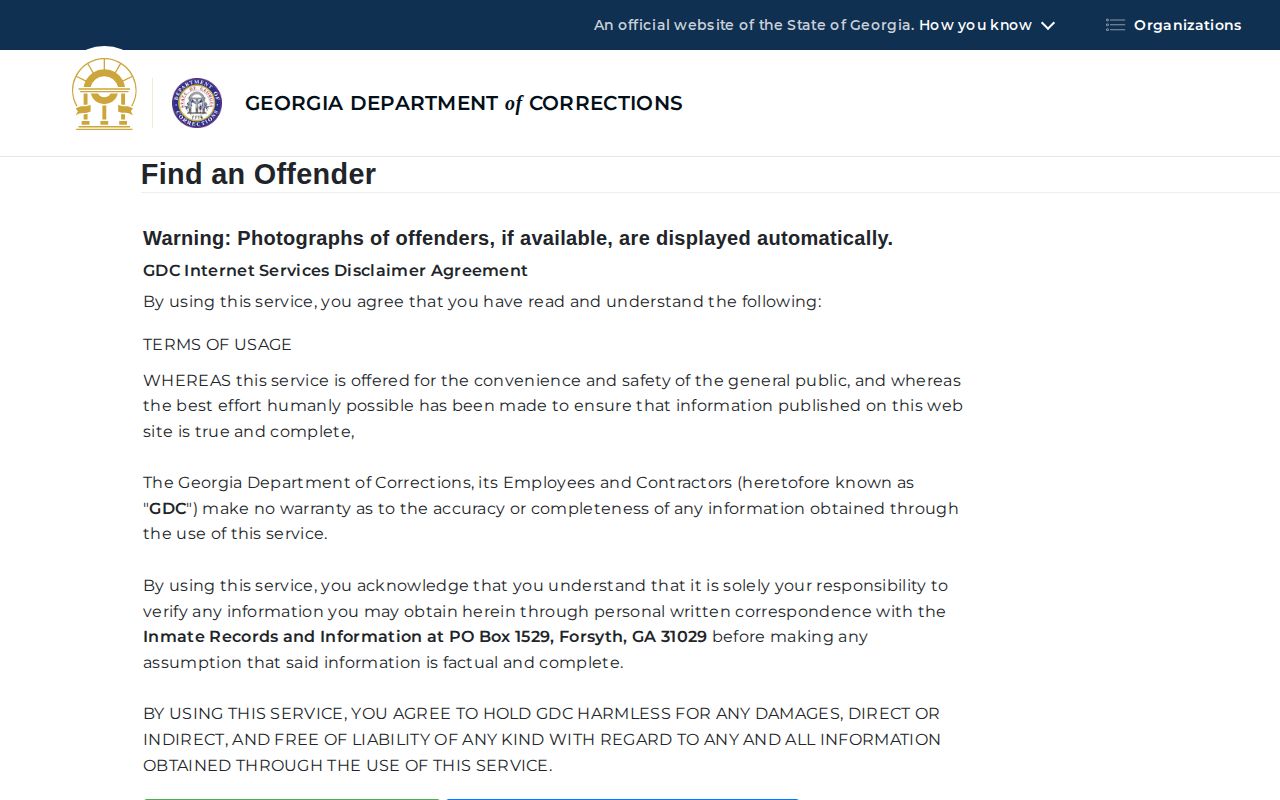
The search screen is the entry point, not written verification. GDC instructs users who need verification to correspond with Inmate Records. State records may include sentence begin and end information, maximum release date, current facility or released status, offenses, and parole links. The Release Date Lookup guide explains why a maximum release date and tentative parole month are different.
Court Records Outlast the Jail Stay
Walker County sits in the Lookout Mountain Judicial Circuit and uses several court channels. The county courts directory routes Magistrate, Probate, Superior, State, Juvenile, and Clerk matters. GSCCCA identifies the Walker Clerk of Superior Court as managing Superior, State, and Juvenile records. The correct clerk depends on the charge and court, but its docket can explain bond, dismissal, plea, sentence, or a transfer long after the live custody information changes.
The GSCCCA Walker clerk page supplies office details and court coverage.
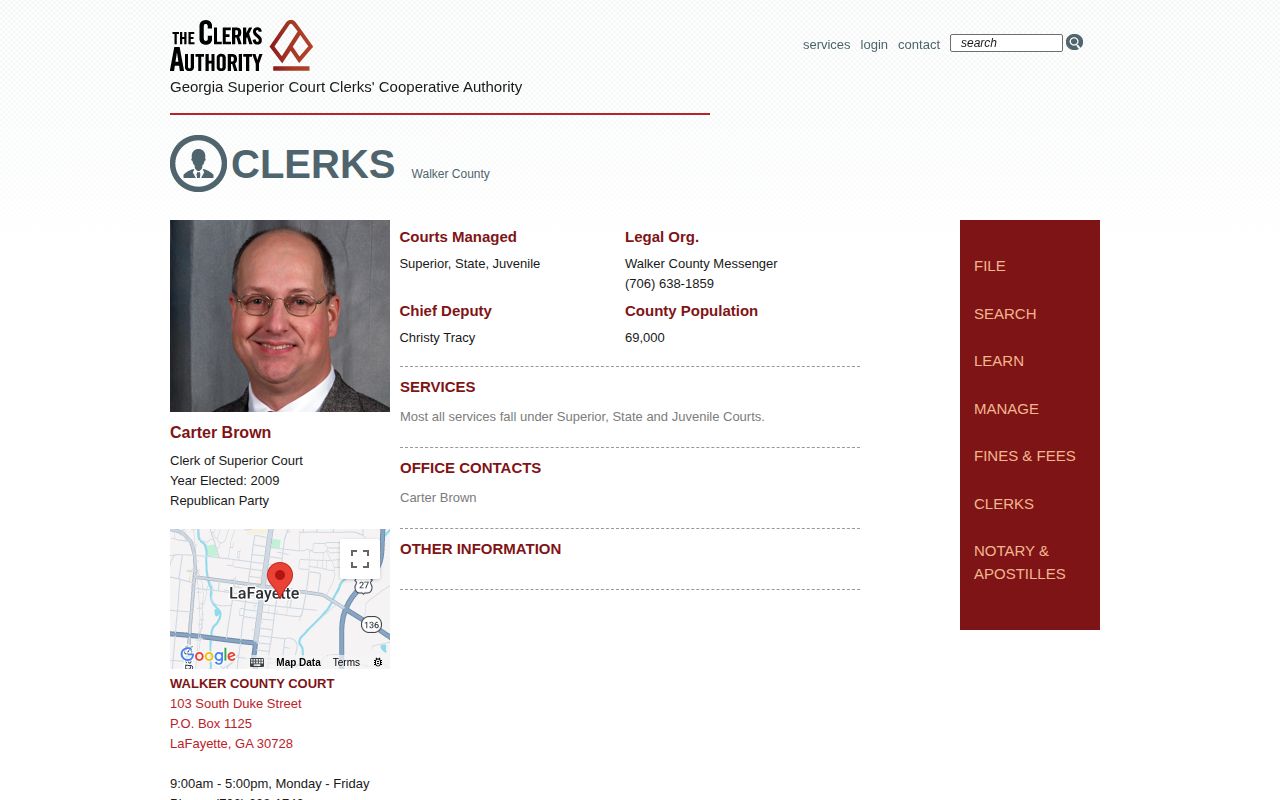
Use the jail record to prove when Walker custody ended and the court record to explain what happened in the case. Neither should be inferred from an online photograph or third-party listing.
Supervision After a State Release
The Georgia State Board of Pardons and Paroles decides parole matters, while the Georgia Department of Community Supervision handles field supervision for parolees and felony probationers. The LaFayette DCS field office at 702 E. Villanow Street serves Walker and nearby counties. A tentative parole month is not a final release date; confirm an actual transition through GDC, the Parole Board's parolee tools, and DCS. See Post-Release Supervision for the local reporting and verification paths.
Walker Prison Programs and Reentry
Walker State Prison is a Faith & Character Based facility. GDC lists RSAT, counseling, education, vocational and on-the-job training, veterans and fatherhood services, mentoring, family services, and work details. These programs can shape release planning, but participation does not guarantee parole, credits, or a particular date. Northwest RSAT is housed within the prison and can involve a program completion or return to supervision rather than an ordinary prison discharge.
Property After Booking or Release
The sheriff gives newly booked inmates 72 hours to release property. Family and friends cannot bring property into the jail. For remaining belongings, the person must sign a release form and the property must be collected within 30 days or it will be destroyed. This property deadline is not a 72-hour release roster and does not prove that the person left custody.
VINE, Federal, and Immigration Checks
Georgia VINE can report custody status and accept notification registrations when the participating agency supplies a record. Treat a released notice as a custody change and obtain the reason from the holding agency. For federal sentences, search the BOP Inmate Locator; a past release date with no facility generally indicates the person is no longer in BOP custody. For ICE custody, use the Online Detainee Locator System by identity or A-number. The U.S. Marshals Service may house federal detainees in partner facilities, so a local transfer does not establish federal release.
Released or Still Held: Choose the Record
| System | Best use | Important limit |
|---|---|---|
| Walker AIS and detention | Current local custody and immediate status questions | Processing can lag and absence is not a release reason |
| Sheriff release entry | Local release date, time, reason, or transfer | Must often be requested |
| Court docket | Bond, dismissal, sentence, and disposition | Does not replace jail timestamps |
| GDC offender search | State custody, prison location, or state release status | Not a county-jail roster |
| Parole Board and DCS | Parole decisions and post-release supervision | A tentative month is not final |
| VINE | Custody events and alerts | Coverage and displayed fields can vary |
| BOP or ICE | Federal or immigration custody | Separate from Walker and GDC systems |
Three Walker County Custody Settings
Walker County Jail / Walker County Detention Facility at 105 South Duke Street is the local booking and short-term custody facility. Its releases are confirmed through the sheriff, courts, VINE where available, or a receiving agency.
Walker State Prison at 97 Kevin Lane in Rock Spring is a medium-security GDC institution. State release questions belong with GDC, the Parole Board, and DCS.
Northwest Residential Substance Abuse Treatment Center is located within Walker State Prison. A departure may mean program completion or a supervision change, so GDC, court, and DCS records are more useful than the county jail system.